
The Sneaky Reason to Be Excited about J.J. McCarthy

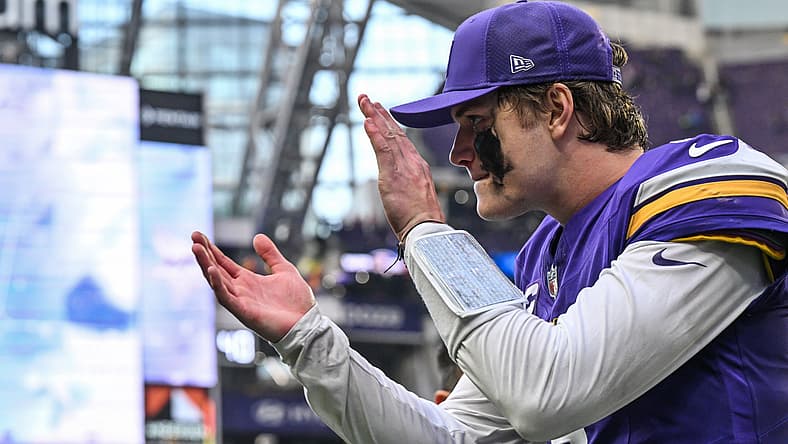
Until Week 14 against the Washington Commanders, the court of public opinion lingered quite low on Minnesota Vikings quarterback J.J. McCarthy. But thanks to a single timely performance — yes, just one is cause for celebration — there’s an undercover reason to be optimistic about the 22-year-old.
Vikings QB J.J. McCarthy is quietly improving at the right time, and there’s a sneaky reason to be genuinely excited about his development.
McCarthy delivered 3 touchdown passes and no turnovers on Sunday, perfect timing for a passer who desperately needed such an outing.
The Covert Jump J.J. McCarthy Is Making Right on Schedule
It’s the dropbacks.
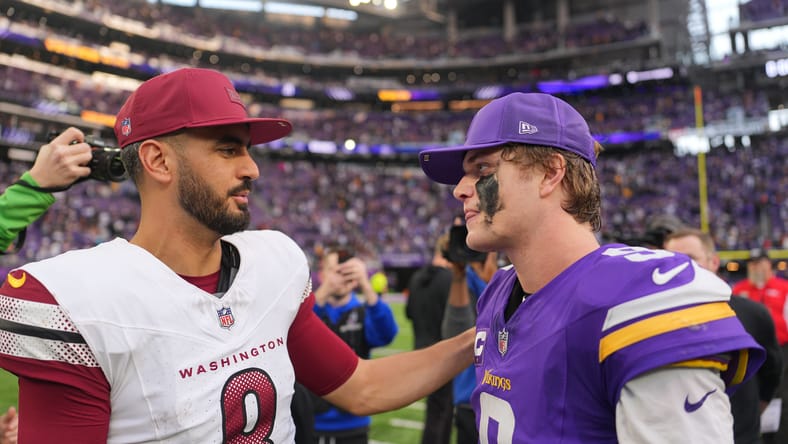
QBs Show True Colors at 250-300 Dropbacks; McCarthy at 238
It may be hard to believe, but NFL quarterbacks do not take any semblance of final shape, on average, until 250-300 dropbacks. Anything before that range is typically considered gravy when a quarterback’s career is in the rearview, and analysts have the advantage of hindsight.
McCarthy now has 238 dropbacks (opportunities to throw the ball, not hand it off), and he saved his best game for the eve of the 250 dropback mark. That means something.
NFL analyst Connor McQuiston wrote last year, “When we talk about the ‘real-ness’ of any rookie QB’s early season performance, we want to know when we can say their results are reflective of their talent and not just the random noise of a couple games.”
“We can arrive at a more precise measure of when statistics begin to stabilize by employing the ‘padding approach’ commonly used by Kostya Medvedovsky (creator of DARKO), Justin Kubatko, and Tangotiger.”
That’s a fancy way of saying that 250-300 dropbacks are the sweet spot for future indicators of performance.
McQuiston added, “The distribution of potential stabilization points ended up as a nice bellcurve between 250 and 300 dropbacks. The average of 272.57 dropbacks minimizes the error in our projections and I have no reason to pick anything else, that is our optimal stabilization point!”
“If we assume that QBs average 30 dropbacks a game, this means that our projections of their future performance become mostly reliant on their past performance after 9ish games.”
And 272.57 dropbacks will occur for McCarthy in the next one, two, or three weeks. If McQuiston’s study is worthwhile — it probably is — fans saw a truer form of McCarthy on Sunday against Washington than any other time.
The Time Is Now to Reveal True Colors
What does this mean? Well, if McQuiston is on to something, it doesn’t necessarily mean “the best is yet to come,” but the verdict to end all verdicts on the immediate future of Vikings football isn’t far away.
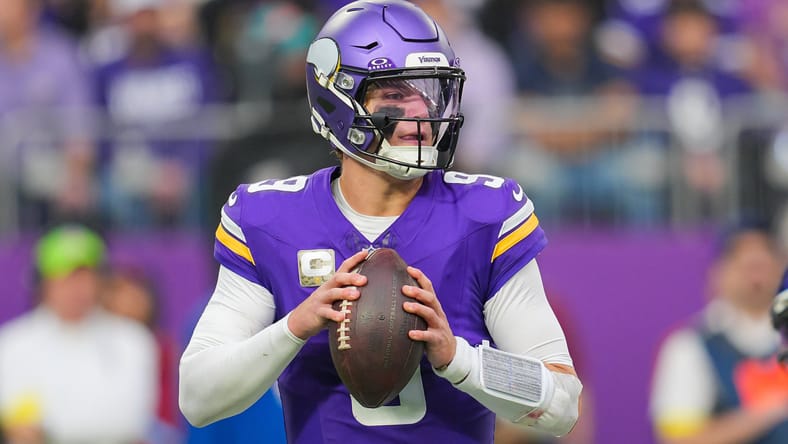
McCarthy, even when struggling, has somehow shown the knack for clutch performance in the 4th Quarter, and fans have commended him for it. Games against the Chicago Bears (twice) and Detroit Lions come to mind. But aside from those moments and Week 14, McCarthy has posted historically poor efficiency.
That changed versus the Commanders, and as McCarthy approaches McQuiston’s “magic number,” he played his best game yet. Probably not a coincidence.
The Jared Goff + Josh Allen Example
Most quarterbacks who struggled so intensely through six starts, as McCarthy did, don’t amount to much. They just don’t. Most are later considered busts.
There are exceptions to the rule, however. The most prominent recent examples are Jared Goff and Josh Allen. Here’s the EPA+CPOE skinny:
- McCarthy at 230 Dropbacks = -0.017
- Josh Allen at 230 Dropbacks = -0.020
- Goff at 230 dropbacks = -0.036
It’s hard to believe, but at the same dropback number, McCarthy has outpaced Goff and Allen.
Those examples bring a wee bit of hope. It, indeed, has happened before where a quarterback is so bad — before turning so good.
More True Colors at DAL and at NYG
At U.S. Bank Stadium against Washington, folks may have watched a McCarthy teaser.
He’s one week away from the 250-300 dropbacks mark, on deck to surpass 250 at Dallas on Sunday Night Football. McCarthy will tunnel deeper toward the 300 dropback range in New York the following week.
If one believes in the historical accuracy of EPA+CPOE and how long it takes for a quarterback to settle, folks should see the “real” version of McCarthy in the 2nd Half at Dallas and all of Week 15 at the Giants. In that regard, the Cowboys and Giants contests become must-see television.
More McCarthy Takes
Zone Coverage‘s Tom Scheirer wrote about McCarthy after Week 14, “McCarthy was playing free. He looked like the quarterback who led the Vikings on a fourth-quarter comeback in Chicago, or who delivered a victory in Detroit as 9.5-point underdogs. For 60 minutes on Sunday, he left the muddled quarterback who threw for 87 yards and two picks at Lambeau Field in the past.”
“It was the first time since Minnesota’s win in Detroit, previously the Vikings’ only win after the bye, that their offense took flight under McCarthy. McCarthy spent last season in the Vikings facility, learning Kevin O’Connell’s offense. However, he could practice his footwork and mechanics while recovering from his meniscus tear.”
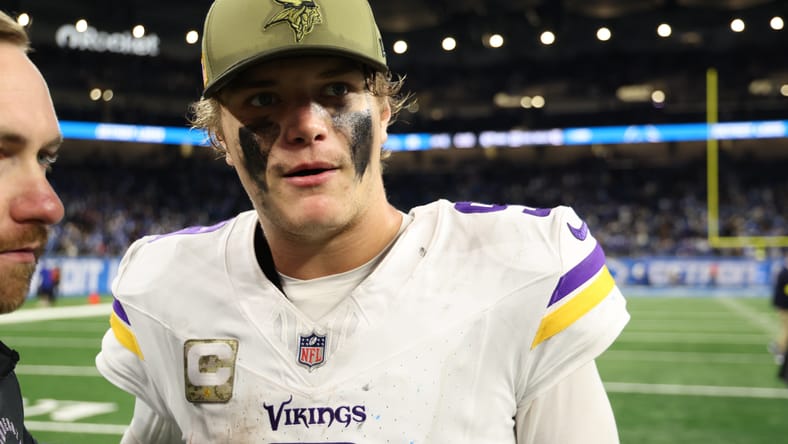
The Vikings also ran the ball at an impressive clip, making McCarthy’s life easier in Week 14.
“To bring out the best in McCarthy, O’Connell asked McCarthy to focus on making the right reads and protecting the football instead of the mechanics of throwing the ball. McCarthy played free and delivered his best performance since Week 9 in Detroit. It felt like he had salvaged the season after the Los Angeles Chargers had routed them 10 days earlier,” Schreier added.
“Those notions are long gone. Still, McCarthy salvaged the belief that he could lead this team into the future if he builds on this win over the next four games.”
Circle the next two games for McCarthy. Per history, they are the sweet spot for indications of future performance.

You must be logged in to post a comment.