
Former Vikings GM Weighs In on Team’s Draft

I say every April, after the NFL draft, that I think it’s ridiculous when so-called draft analysts in the media give grades to team drafts immediately afterward. The reality is that it takes at least two to three years to truly evaluate how a team did on draft day.
Example A — Tom Brady as a sixth-round pick in 2000 when he was a skinny QB out of Michigan. Example B — when the Chiefs traded their 27th overall pick and a third-rounder in 2017, plus their 2018 first-round pick, to move up to No. 10 overall and select Patrick Mahomes in a move that was considered risky for a “raw” prospect who played for Texas Tech in the then-no-defense Big 12.
Then there’s Joe Montana and Russell Wilson as third-rounders turned top QBs and Super Bowl champs.
Jeff Diamond Sees Upside — and Risk — in Vikings Draft
With 15 Super Bowl titles, 11 Super Bowl MVPs and 39 Pro Bowls between them, those picks turned out pretty, pretty good (as Larry David would say on Curb Your Enthusiasm) for the Patriots, Chiefs, 49ers and Seahawks. Their drafts would’ve been graded A+ a couple of years later just because they found their ultra-successful franchise quarterbacks.
Closer to home, Fran Tarkenton was a third-round pick in 1961, and it was hard to predict he would lead the Vikings to three Super Bowls and become an NFL MVP, nine-time Pro Bowler, and Pro Football Hall of Famer.
If J.J.McCarthy and Dallas Turner turn into All-Pros who someday lead the Vikings to the promised land, we’ll give the 2024 draft an A+ for the Purple after they picked McCarthy and Turner in the first round. Sixth-rounder Will Reichard already is an All-Pro kicker from that draft class.
So while I can certainly give the Vikings’ 2022 draft, which has no players still with the team, a resounding F, I’m not going to grade the Vikings’ just-completed 2026 draft for a couple of years. What if Caleb Banks stays healthy and is the next Chris Jones or Kevin Williams as a big, dominating defensive lineman? What if several of the remaining picks become starters, and a couple turn into top players?
Time will tell, but I do have several reactions as follows, and I’ll go round-by-round and hit on the Jonathan Greenard trade that I was not thrilled by:
Caleb Banks — DL, Florida — Round 1:
I respect and agree with always picking the best player available regardless of position (unless it’s a quarterback and the team already has a “franchise QB”). So I have no problem with the Vikings picking Banks as the top player on their draft board at No. 18 overall if he stays healthy and is a productive starter.
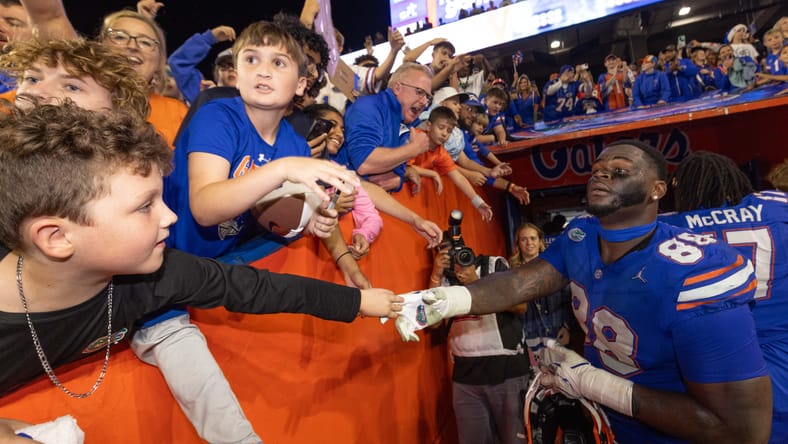
My problem is with his recent injury history: a broken foot that cost him all but three games last season at Florida, followed by breaking the same foot at the Combine, which he said happened as he was practicing starts for the 40-yard dash the night before he ran it.
The team doctors obviously signed off on Banks as a player who will recover from his recent foot surgery and have a long, healthy career (they better have done that). A big, strong run-stuffing D-lineman is great for the Vikings, who slipped last season from No. 2 to No. 21 on run defense. If Banks can provide an inside pass rush to push the pocket a la Chiefs’ All-Pro Chris Jones or Kevin Williams (five-time All-Pro for the Vikings in the 2000-2009 decade), we’ll all call this a great pick.
Perhaps Banks will turn into an elite player, but I believe it’s too risky to use a first-round pick on a 330-pounder with a recent history of foot problems (that’s a lot of weight on his feet). I would’ve taken a safer player, such as safety Dillon Thieneman (or whoever they had the highest grade on at the time who did not have injury questions).
Jake Golday — LB, Cincinnati — Round 2:
I like that Golday brings size and versatility as a defender who played inside linebacker and edge rusher in college. He will be a quality pick in the second round if he can be a run-stopping inside backer, good cover outside LB, and/or the third edge rusher with Andrew Van Ginkel and Dallas Turner, and be a projected replacement for Greenard (which I doubt he’ll be as effective at least this season).
I have to wonder if the Vikings should have taken highly-rated safety Emmanuel McNeil-Warren (who went No. 58 to Cleveland) at Golday’s No. 51 spot to fill a big need position (again, if McNeil-Warren graded out at about the same level as Golday; if not, then I say go with the higher-rated Golday). Or take a center at another big need position since two highly-rated centers went after Golday in the second round–Logan Jones to the Bears at No. 57, and Jake Slaughter was picked at No. 63 by the Chargers.
Again, I don’t advocate for picking a lower-rated player at a position of need over the best player available in the first three rounds. But it will be interesting to follow the players I mentioned above that the Vikings passed on.
Domonique Orange — NT, Iowa State — Round 3a
It’s great to have a rotation of quality defensive linemen. Many championship teams have used that formula. The Vikings should have an excellent rotation of run-stuffers and pocket pushers. Orange certainly looks like he’ll be great against the run and help free up inside backers Blake Cashman and Eric Wilson to make a lot of plays.

In my early years with the Vikings, our terrific player personnel execs, Jerry Reichow and Frank Gilliam, always prioritized picking top defensive and offensive linemen early in the draft, so we were strong in the trenches. I like the Orange pick to help with that.
Caleb Tiernan — OT, Northwestern — Round 3b
I saw enough of backup tackles David Quessenberry and Justin Skule the past two seasons—and so apparently did Kevin O’Connell—to know the Vikings needed a better backup OT with elite tackles Christian Darrisaw and Brian O’Neill missing time due to injuries and the Vikings’ QBs not being well enough protected by the replacements.
Tiernan is another big guy at 6-8, 323 pounds, and he may be able to play guard too if needed. Again, if he was their highest-rated player at No. 97 over a center or wide receiver (to compete for the third WR spot after Jalen Nailor’s free agency departure and they did select a safety at No. 98) and he is a quality O-lineman who can be developed into a better lineman than Ryan Van Demark who was signed this offseason, then I’m on board with Tiernan as the swing tackle/guard and as a possible future starter with O’Neill turning 31 in September.
Jakobe Thomas — S, Miami — Round 3c
Thomas was clearly a need pick, and as the Vikings’ third pick in the third round, I have no problem going need here. We’ll see if Thomas pans out as a safety who is comparable to Thieneman or McNeil-Warren. I like his college production, with five picks and only one TD allowed in coverage last season, on a Miami team that made it to the title game. He was also an effective blitzer, which fits what DC Brian Flores wants out of his safeties.
I think the Vikings still need Harrison Smith to return and have Thomas as a potentially better cover safety than Josh Metellus, Theo Jackson, or Jay Ward. He should certainly be a good special teams player in his rookie season, and the Vikings hope he can become a quality starter sooner rather than later. O’Connell praised Thomas as “a very, very highly intelligent player,” which bodes well for him to earn a starting spot in Year 1 or 2 at the latest.
Max Bredeson — FB/TE, Michigan — Round 5a
With C.J. Ham’s retirement, Bredeson will have the opportunity to step into Ham’s fullback and special teams role and get on the field in his rookie year, possibly playing 20-40% of the offensive snaps depending on the opponent and how the game is going, and he should play on most, if not all, of the special teams. He is an excellent blocker and should be good in pass protection, which would help the run and pass game. Bredeson seems to be a good fifth-round pick.
Charles Demmings — CB, Stephen F. Austin — Round 5b
There’s a lot to like about Demmings’ potential as a third or fourth corner and special teamer. He’s fast and athletic, as shown by his 4.41 40 and 42-inch vertical jump at the Combine. The question will be how quickly he can adjust to the NFL and cover receivers who are a significant step up from those he covered in college for a smaller school—Stephen F. Austin.
It will be interesting to see Demmings line up against Justin Jefferson and Jordan Addison in OTAs, minicamp, and training camp, and then watch him in preseason games to see how NFL-ready he is.
Demond Claiborne — RB, Wake Forest — Round 6
Claiborne is a very intriguing late-round pick. He brings big-time speed (4.37 in the 40 as the third-fastest time at the Combine) and a dual threat as a quality receiver out of the backfield. If he can pass protect, Claiborne should have opportunities to contribute as a rookie since Aaron Jones usually misses a few games.
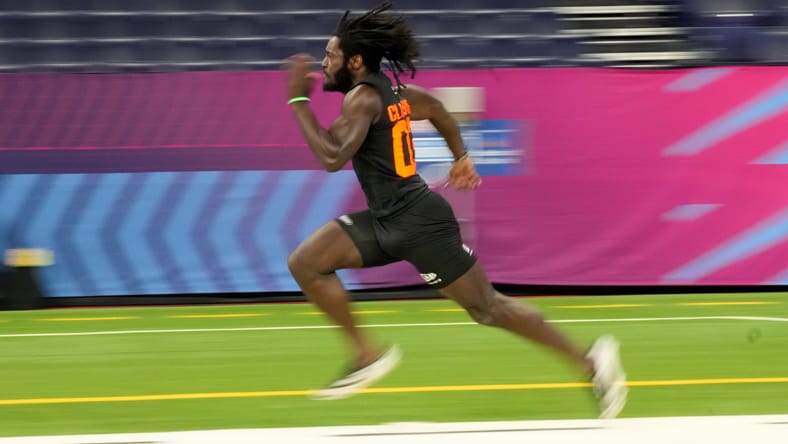
I like his potential to be a bigger contributor in future years. He could also be a good kick returner with his elite speed and running ability. The Vikings would love to see Claiborne become the next Terrell Davis, a sixth-round running back steal by Denver in 1995 who went on to become an NFL and Super Bowl MVP and a Hall of Famer.
Gavin Gerhardt — C, Cincinnati — Round 7
Gerhardt brings plenty of college experience (49 starts) and may wind up as the Vikings’ starting center someday, but it was disappointing that the Vikings waited until the seventh round to draft the position I thought was their most critical need following the retirement of the often-injured Ryan Kelly. The Vikings also didn’t sign a top center when several were available in free agency.
Blake Brandel is the projected starting center this coming season, and he’ll have to step up his game at a position he played in a few games last season when Kelly was hurt. Gerhardt should be able to win the backup center job over Michael Jurgens, who has struggled in his limited play time over the last two seasons.
Other Vikings Draft Reactions and thumbs down on the Greenard trade
As I said, I would’ve liked to see a center drafted earlier and a wide receiver picked in the third or fifth round to compete for the third wide receiver role. It will work out fine for this year if last year’s third-rounder, Tai Felton, makes a big jump in his second season or if the Vikings can sign Jauan Jennings, who played well for the 49ers the past two seasons (132 catches, 1,618 yards, and 15 TDs over 2024 and 2025). Jennings is a free agent who is reportedly set to visit the Vikings this week.
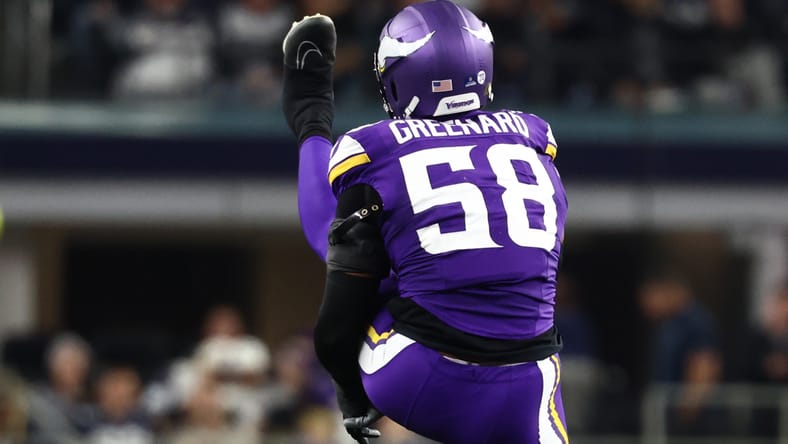
On the Greenard trade: I didn’t like trading one of the best edge rushers in the league for two third-round picks. I think the Vikings should’ve held out for a second-rounder, or, better yet, kept Greenard for at least one more year to see if he can return to his 2024 production, when he had 12 sacks and was a Pro Bowler.
He had two years left on his contract, and I think a solution to his contract demands for a new deal (that the Eagles gave him with a $25 million per year extension, an upgrade from his $19 million per year Vikings deal) could’ve been to give him a big incentive package that would kick in if he returned to double-digit sacks. Since he only had three sacks last season, anything over three sacks would not likely be earned and would not count against the salary cap.
That was what we did in Tennessee for Jevon Kearse when he had outplayed his rookie contract by his fourth season in 2002, and it just so happened that Jevon’s agent was Drew Rosenhaus, who also represents Greenard, so there was precedent for putting such a compromise in place with Rosenhaus.
The bottom line is the Vikings would be a better team coming out of the draft if they had kept Greenard and taken McNeil-Warren at safety instead of Golday in the second round, and perhaps Golday would’ve made it to the third round when they drafted Thomas at safety. But maybe Golday and Thomas will prove to be great players, and Greenard will get hurt again.
If Greenard stays healthy, he’s a proven great player, and drafted players are projections, but we’ll have to see how it all plays out.
Next week: I’ll analyze all four NFC North teams after free agency and the draft.

You must be logged in to post a comment.