
One Side Is Taking Heat for the Kyler Murray Situation

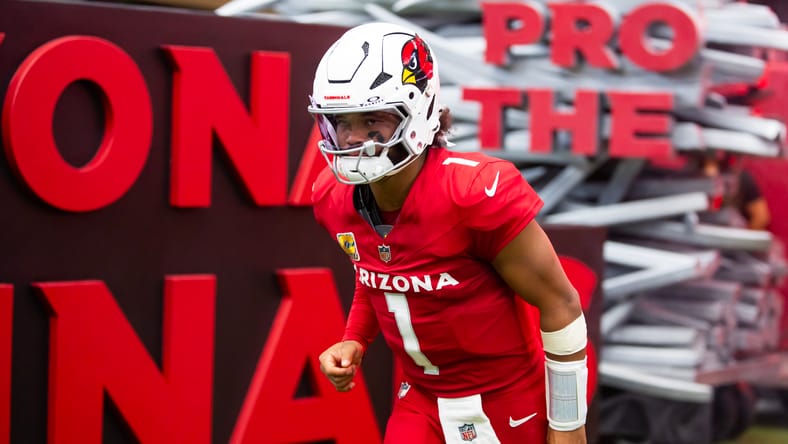
Have you wondered over the last month why the Arizona Cardinals didn’t trade Kyler Murray instead of releasing him? You’re not alone.
Arizona may have misread the market, and the Vikings could end up benefiting from that whiff in a big way.
The Cardinals’ brass kicked Murray out last month for nothing, and a few weeks later, folks are wondering why the process didn’t shake down differently.
Arizona’s Murray Decision Looks Worse through a Vikings Lens
Yes, it’s odd that Murray never scraped the surface of trade talks.
The Questions about Murray’s Offseason Fate
The Athletic‘s Mike Sando published behind-the-scenes fodder from NFL free agency last week, and the Cardinals kicked off the festivities.
One anonymous executive told Sando. “I feel like they could have done a lot of different things, but they chose not to. They just wanted him off the roster, wanted to save the $19.5 million (in 2027 salary that would have become fully guaranteed this month). They did not want to mess with it. I don’t know why. They don’t have a good enough roster where that $19.5 million really matters.”
Another opined: “I don’t know why you would not just keep him on your roster for the whole season and then figure it out next year. You could probably trade him straight up off the $19.5 million, or if you cut him, then he’s making $1.5 million next year with someone else, so it’s an $18 million risk. If you can get a third-round pick for him, that is well worth the risk.”
“How were the Cardinals not able to trade him to the Jets, eat $35 million this year, and then the Jets are on the hook for the $19.5 million next year? That is basically two years at $25 million. The Jets would not have signed up for that?”
And these are questions Vikings fans have asked for about three months.
The Kirk Cousins Example
Cousins encountered a very similar situation to Murray — and somehow managed to earn $20 million in 2026 with his deal in Las Vegas. One must ask: why didn’t Murray get the Cousins treatment? Was his agent not smart enough to figure it out? Did the Vikings proceed that shrewdly and make it so that Murray would sign for the league minimum? That doesn’t sound like typical Vikings’ operations.
Think of it this way: the Cardinals released Murray. The Atlanta Falcons released Cousins. Murray grabbed a contract worth $1.3 million from Minnesota. Cousins got $20 million.
How was Cousins able to finesse a team while Murray did not? It adds more fuel to the fire surrounding Murray’s exit from Arizona.
Cardinals Depreciated Murray’s Value
Of course, Arizona has itself to blame for failing to create a Murray market through trade. As Murray mitigated a foot injury in 2025, the Cardinals inserted Jacoby Brissett into the starting lineup, who posted impressive raw statistics for a QB2 while his team piled oodles of losses. When Murray began to get close to a comeback, the Cardinals left Brissett in the lineup, prompting media members to ask if Murray had been “softly benched.” The Cardinals’ coaching staff and front office did next to nothing to refute the narrative.
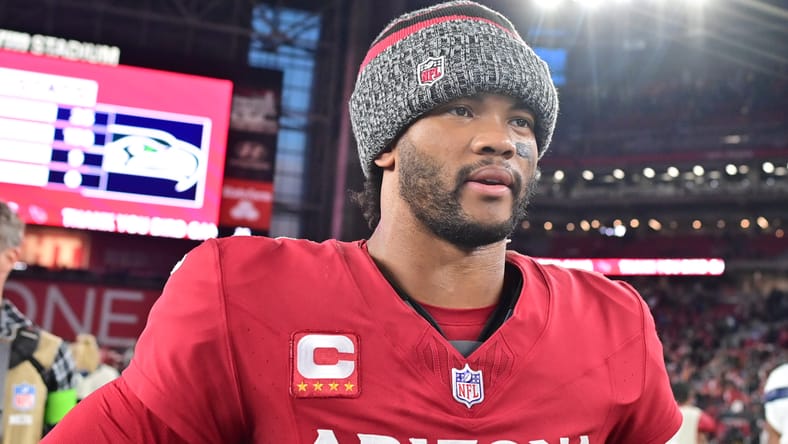
So when it was time to choose an off-ramp for Murray this offseason, there apparently wasn’t a robust trade market for a man who had been benched for Brissett. As recently as the middle of the 2024 regular season, before the trade deadline, the asking price for Murray would’ve been at least two 1st-Rounders.
Fast forward to March 2026, and the Cardinals cut Murray for nothing.
Vikings as the Beneficiary
Murray enters a favorable situation in Minnesota. The Vikings’ offensive line flashed potential last year despite injuries and roster instability, implying further growth is possible. The defense was elite under Brian Flores, ranking in the top three in both DVOA and EPA/Play.
Offensively, Kevin O’Connell leads a unit brimming with skill-position talent, including Justin Jefferson, Jordan Addison, T.J. Hockenson, Aaron Jones, and Jordan Mason. Even with inconsistent quarterback play, the team managed a 9–8 record last season, suggesting a solid foundation for Murray’s arrival.
Murray also doesn’t need to play at an MVP level to lead this team to victories. Consistent, above-average quarterback play should be enough to swing some of last season’s losses; in several games last year for the Vikings, even competent quarterback play would have secured a win.
While he’s not expected to simply “manage,” the bar for playoff contention isn’t unreasonably high. Consider Baker Mayfield’s performance in Tampa Bay — efficient, composed, and capable of making key plays. If Murray can replicate that level of play, Minnesota should be in a strong position, with even greater potential if he finds his rhythm.
Murray shouldn’t be viewed as merely a short-term solution, a route the Vikings have already explored with quarterbacks like Sam Darnold. If Murray performs well, there’s no reason he can’t be a long-term fixture in Minnesota. His playmaking ability and arm talent raise the team’s ceiling, offering the Vikings an opportunity for sustained success rather than another rebuild.
All because the Cardinals may have bungled Murray’s departure.

You must be logged in to post a comment.