
The Jonathan Greenard Money Update Will Go Over Like a Lead Balloon in Minnesota

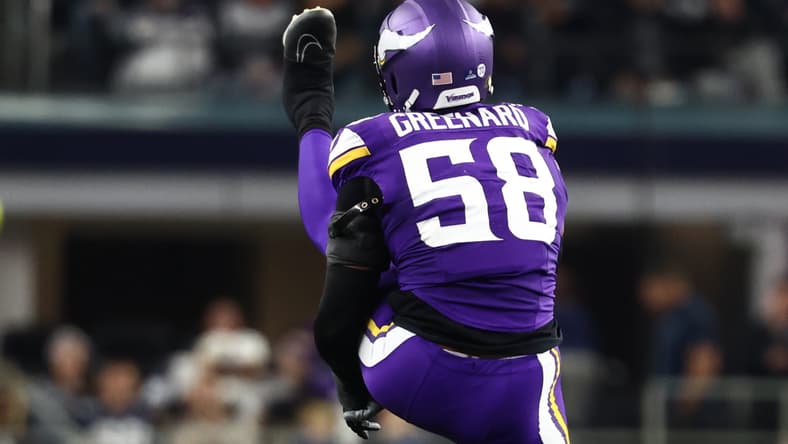
The leadership group in Eagan, Minnesota didn’t want to offload edge rusher Jonathan Greenard. A combination of factors — a snug budget, the appeal of two 3rd-Round selections, the presence of youthful replacements, and so on — led to a swap with the Eagles.
Philadelphia is now working with a new EDGE1. Greenard will be a tremendous addition to what is a loaded Eagles roster, a team that’s good enough to win it all in 2026. Part of what makes his deal in Philadelphia notable is that his initial cap charges are ultra low, perhaps leading to some frustration in the Twin Cities.
The Jonathan Greenard Cap Update
A tip of the cap to Over the Cap (pun intended). Consider the cap charges moving forward:
- 2026: $6,278,000
- 2027: $11,139,000
- 2028: $15,796,000
- 2029: $20,204,000
- 2030: $44,433,000
There’s a need to clarify those numbers, but don’t forget the Vikings’ end of things before the trade. Originally, Jonathan Greenard arrived in Minnesota from within that fantastic free agency haul from 2024. He did so for the promise of four years and $76 million. Demanding $19 million per season quickly looked modest within the context of NFL pass rushers, but he’s coming off a 3-sack season where he battled injury.

His Vikings deal had just two more seasons — 2026 and 2027 — and was chewing up $22.3 million on the cap for the upcoming season. Some may therefore be asking: how in the world did the Eagles drop the cap charge so low? Good question.
Begin with the basic reality that some of that cap charge stuck around in Minnesota, helping Philadelphia. The Vikings see $9.9 million left behind as dead money. That’s the leftover signing bonus cap charges, which can’t get moved in the NFL. But, to be sure, there could be some frustration by the Vikings’ cap having a beefier Greenard charge based on dead money than the Eagles’ cap being at roughly $6.3 million.
There’s then the Eagles getting super frisky with void years.
In 2030, Jonathan Greenard isn’t under contract. He is nevertheless seeing the largest bite of the pie kicked into that season. Philly’s management has worked the NFL’s bonus system to kick a ton of Greenard’s cap charges into the future. Eventually, the bill is going to come due and the cap is going to get hit with dead money. Philadelphia is therefore akin to New Orleans — a different team that kicked the can down the road for a while — but operating in a manner that demonstrates Philly is considerably smarter.
Philadelphia has opted for short-term gain in the name of long-term pain. Worth it? Depends who you ask, of course, but there’s a persuasive case that it is worth it. After all, the Eagles are in a contention window that probably isn’t open in four years. Rebuild at that point as the cap tries to heal.
Jonathan Greenard is going to turn 29 in May. He’s still very good but is likely to be a step slower in four years. The Eagles have therefore synced the money with the expected player performance, investing in the present moment accordingly.

Bringing things back to Minnesota means seeing a team that is working through a transition at edge rusher.
At the top of the position is Andrew Van Ginkel, who is closer to being a cyborg than a normal human. The ultra talented Dallas Turner is widely expected to become the EDGE2.
The Vikings then have a collection of young fellas — Bo Richter, Tyler Batty, and others — at edge rusher alongside the off-ball linebackers who can play along the edge. Most notably, there’s Eric Wilson, but Jake Golday has a build and college history that suggests he’ll line up over there. Minnesota could also pivot toward a mercenary for hire, signing someone like Jadeveon Clowney.
Jonathan Greenard is 6’3″ and close to 260 pounds. He’s not the athlete that Everson Griffen was, but Greenard is similar insofar as he’s an all-effort, rugged defender who terrorizes quarterbacks. Provided health cooperates, Greenard is going to be a monster for the Eagles.
Philadelphia and Minnesota aren’t scheduled to play each other in 2026.

You must be logged in to post a comment.