
What the Vikings Actually Mean by “Best Player Available”


Minnesota Vikings interim general manager hinted last week that his team will draft the “best player available” at pick No. 18 later this month, a popular mindset for most NFL teams. But what does that really mean? Let’s take a peek.
Minnesota may follow the board, though some positions clearly carry more traction than others in Round 1.
Remember: picking the best player available disregards roster need, almost altogether. This analysis does not consider offensive tackles because the Vikings have Christian Darrisaw and Brian O’Neill in the budget at a pretty penny, but in theory, Minnesota could select one of those, too.
The No. 18 Pick Feels More Like a Targeted Shortlist with BPA Involved
The BPAs for the Vikings at No. 18.
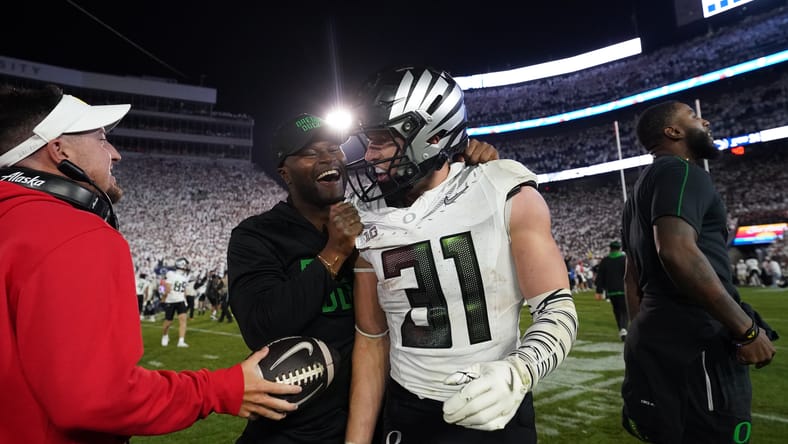
5. Dillon Thieneman | S, Oregon
Thieneman lives at No. 17 on the Pro Football Network Industry Big Board and at No. 18 on the Consensus Big Board. His stock has soared since his dazzling performance at the NFL Combine.
Meanwhile, roughly 90% of all NFL mock drafts feature Thieneman to Minnesota; the general public believes it’s happening. The reasoning is clear: the Vikings need a safety, especially if Harrison Smith retires, and Thieneman marries the BPA mindset near No. 18.
Thieneman was not the Vikings’ best-player-available option two months ago, but the Combine changed that.
4. Kenyon Sadiq | TE, Oregon
Sadiq is the only tight end tentatively scheduled to go off the board in Round 1, unless a team feels frisky enough to draft Vanderbilt’s Eli Stowers around Pick No. 32.
At 6’3″ and 245 pounds, Sadiq boasts 42 games of experience at Oregon, where he recorded 80 receptions for 892 yards and 11 touchdowns. Highlighting his rare athleticism, the Ducks even used him on kick returns in 2023 and 2024.
The versatility has generated Round 1 buzz. Sadiq not only handles a significant receiving workload but also excels as a blocker in both the run and pass game. This combination is uncommon for tight ends his age, and teams tend to invest early in that kind of potential.
Meanwhile, the Vikings TE1, T.J. Hockenson, is scheduled to hit free agency in 2026. Picking Sadiq would plan for 2027.
3. Jermod McCoy | CB, Tennessee
The Vikings are projected to start Byron Murphy Jr., Isaiah Rodgers, and James Pierre at cornerback through 2026. While Murphy Jr. played well in 2024, his performance declined slightly last season. Rodgers has impressive speed and agility, but his tackling consistency remains a concern. The team still seeks a definitive, young CB1, a role McCoy could potentially fill.
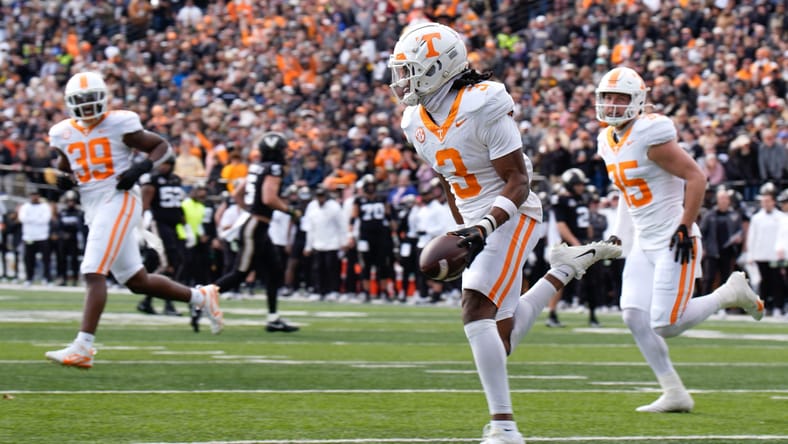
Perhaps more concerning is the Vikings’ historical struggle to find a long-term cornerback solution, a search that has lasted nearly a decade. Trae Waynes, drafted in 2015, came closest to meeting expectations, but ultimately fell short. Since Waynes, a series of unsuccessful picks — including Mike Hughes, Jeff Gladney, and Andrew Booth — have failed to establish themselves with the team.
McCoy blends BPA and team need.
2. Jordyn Tyson | WR, Arizona State
Minnesota obviously has Justin Jefferson and Jordan Addison to headline the passing offense; most draft pundits expect Tyson to become a WR1, not a WR3.
Tyson played at Colorado in 2022 and Arizona State from 2023 to 2025, amassing 158 receptions for 2,282 yards and 23 touchdowns. He also handled some return duties early in his career at Colorado, showcasing his movement skills. Projected to run in the mid-4.5 range, his speed will be confirmed at the combine.
His appeal lies in his ability to separate from defenders, run clean routes, and demonstrate reliable hands. However, durability is a concern, as he suffered a knee injury in 2022 and a collarbone fracture in 2024. Teams will likely scrutinize his medical records before finalizing his evaluation.
Tyson is a BPA idea for the Vikings if they wish to get incredibly deep at wide receiver after Jalen Nailor’s departure.
1. Makai Lemon | WR, USC
Speaking of Nailor, who held the WR3 role in Minnesota for two seasons, he’s a Raider. Tai Felton is next in line. However, Felton’s potential impact remains largely unknown, as he saw minimal offensive snaps as a rookie.
Adding to the uncertainty is Addison’s legal situation, casting a shadow over the team’s plans. With his behavior always in question, Minnesota must always be on high alert.

Zooming out, the team’s direction becomes clear: they released Nailor, are prioritizing the draft, and may target a receiver early if the right prospect is available. Lemon could be a strong fit if he’s still on the board. Given the organization’s history of drafting wide receiver talent, coupled with Kevin O’Connell’s offensive acumen, further investment in the position would not be overly surprising.
Lemon’s hands are fantastic, and his separation is elite. He ran a 4.5 forty, which is not dream speed, and he’s undersized at 5’11.” Usually, for smaller receivers, they have speed to rely on. Lemon’s speed is average for a receiver.
Honorable Mention
For offensive tackles, Minnesota could explore Georgia’s Monroe Freeling or Utah’s Spencer Fano. At guard, it’s Olaivavega Ioane from Penn State.

You must be logged in to post a comment.